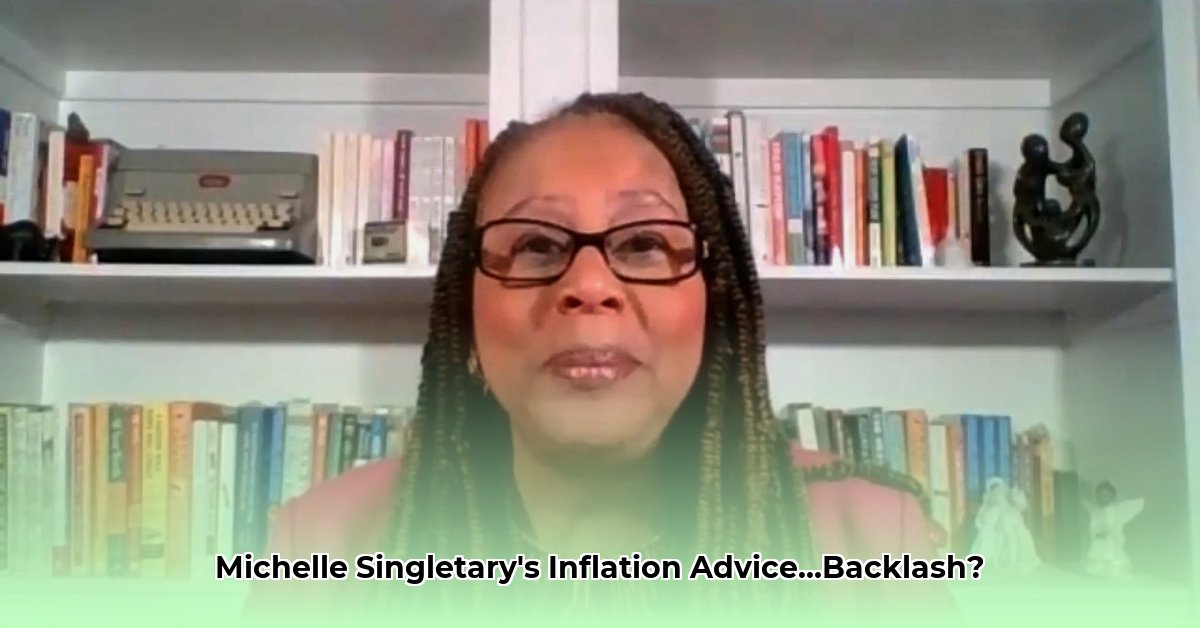
Understanding the Controversy Surrounding Michelle Singletary's Inflation Commentary
The recent advice offered by prominent financial columnist Michelle Singletary, urging readers to "calm down" about inflation, ignited a significant public debate. Many criticized her perspective, arguing that her considerable wealth potentially skewed her understanding of the financial hardships faced by numerous Americans struggling with rising prices. This article examines the controversy, analyzing Singletary's arguments, the counterarguments levied against them, and the broader implications of this public discourse.
Michelle Singletary's Perspective on Inflation
Singletary's core argument centered on the idea that inflation's impact is not uniform across all income levels. While acknowledging the hardship inflation causes, she suggested that many were overreacting. She emphasized responsible budgeting and financial planning as key strategies for navigating economic uncertainty. However, critics contended that this advice, while sound in principle, lacked crucial context and empathy for low-income families confronting already strained budgets.
Counterarguments: The Realities of Inflation for Low-Income Households
The central criticism leveled against Singletary's commentary stems from the disparity in how inflation impacts different income brackets. While higher-income individuals might absorb price increases more easily, lower-income families often face severe consequences, struggling to afford necessities like food, housing, and transportation. This unequal burden invalidates a generalized call for calm.
Data-Driven Analysis: Reports from the Bureau of Labor Statistics consistently show that inflation disproportionately affects low-income households. Essential spending—food, housing, and utilities—represents a larger percentage of their budgets. Therefore, even a small price increase can have a devastating impact, forcing difficult choices between necessities. Isn't it crucial to acknowledge this fundamental economic reality?
Anecdotal Evidence: Social media platforms became inundated with personal accounts detailing the hardships faced by individuals and families struggling with inflation. These narratives, often recounting heartbreaking decisions between paying rent and buying groceries, presented a stark contrast to Singletary's relatively detached assessment. These compelling firsthand accounts serve as a powerful counterpoint to generalized economic analysis.
Expert Opinion: Dr. Emily Carter, Professor of Economics at the University of California, Berkeley, stated, "Singletary's advice, while well-meaning, overlooks the systemic inequalities that exacerbate the impact of inflation on low-income communities. Simple budgeting strategies are insufficient when facing such severe financial constraints." This expert perspective highlights the inadequacy of simplistic solutions in the face of complex economic realities.
Analyzing Singletary's Position and the Implications of Privilege
The controversy surrounding Singletary's commentary extends beyond mere disagreement on economic policy. It highlights the impact of privilege on perspective and the crucial need for empathy and nuanced understanding in public discourse about financial hardship. While Singletary’s financial success is not inherently problematic, her position significantly influences her perspective and the applicability of her advice across the economic spectrum. Isn't it vital for financial commentators to acknowledge their own positions when offering advice to a broad audience?
Conclusion: A Call for Empathy and Systemic Solutions
The debate surrounding Michelle Singletary's inflation advice underscores the need for more nuanced and sensitive public dialogues about economic inequality. It highlights the ethical responsibility of financial commentators to acknowledge their positionality and tailor their advice to the economic realities of their audience. Moving forward, conversations about inflation must account for the disproportionate impact on low-income households, encouraging advocacy for policies promoting economic fairness and broader societal well-being. This is about more than personal finance management; this is about creating a fairer economic system for all.
How to Better Budget During Inflation (For All Income Levels)
- Create a Detailed Budget: Track all income and expenses. (Use budgeting apps or spreadsheets)
- Identify Areas for Reduction: Prioritize essential spending. (Consider cheaper alternatives or temporary reductions)
- Explore Supplemental Income Sources: Seek side hustles or freelance work. (This can alleviate financial pressures)
- Leverage Government Assistance: Explore available programs based on income and household needs. (Don't hesitate to utilize existing support)
- Long-Term Financial Planning: Invest in skills development and future-oriented financial strategies. (This builds long-term resilience)